
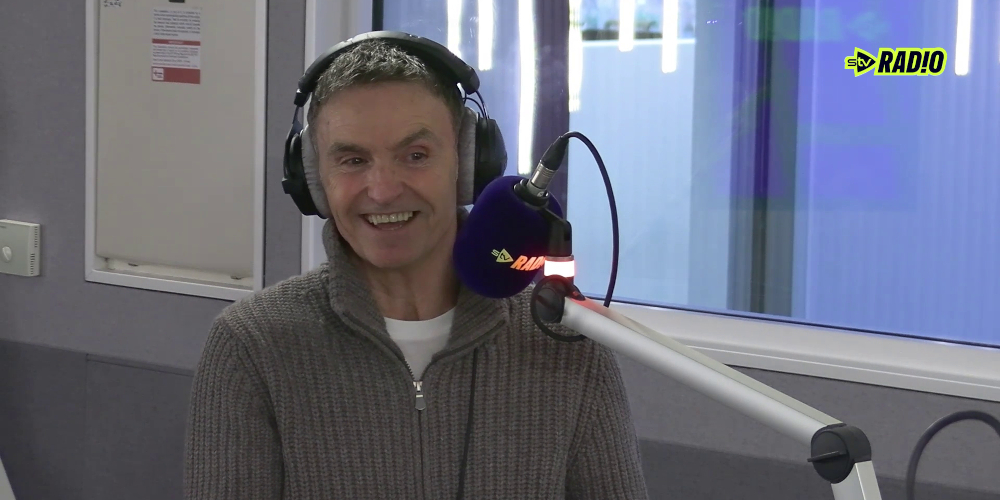
Scottish singer-songwriter Marti Pellow has revealed that Wet Wet Wet’s debut single Wishing I Was Lucky was produced in Edinburgh for just £750.
The global hit, first released in 1987, went on to launch the band’s career and remains one of their most recognisable songs.
Speaking on STV Radio this morning, Marti shared the story behind the track while joining breakfast presenters Ewen Cameron and Cat Harvey for an interview on the new Scottish station.
Marti received a characteristically Scottish welcome on arrival at the studio, with a bagpiper piping him in before he sat down to chat.
After Ewen and Cat played Wishing I Was Lucky on air, the singer explained that the version listeners know and love was originally recorded as a demo.
“We recorded it in Wilf Smarties’ studio in Broughton Street in Edinburgh,” Marti said. “It was a demo and we tried to recreate it with so many different other producers and we ended up putting out the demo.”
He went on to explain that despite pressure from record label executives to rework the track with other producers, the band always felt the original recording had something special.
Marti said they repeatedly tried to convince their A&R team that the song already worked just as it was.
“We used to sit outside the A&R guy’s office and we’d say, ‘there’s the song there’,” he said. “I think it was like £750 or something to do. That was still a lot of money then for us.”
Wishing I Was Lucky reached number six in the UK Singles Chart and later broke into the Billboard Hot 100 in the United States, pushing Wet Wet Wet into international stardom.
The song became a defining moment for the band, who went on to enjoy a string of chart successes and a career across decades.
During the STV Radio interview, Marti was keen to credit his former bandmates for the song’s success.
He described the recording process as detailed, focused, and driven by a shared excitement about what they were creating together.
“That was testament to the rest of the guys in the band,” he said. “We wanted it to be real. We wanted it to be something that connected.”
Marti also revealed that much of the track was captured in a very natural way, with performances recorded quickly rather than endlessly reworked.
He said large sections were completed in single takes, giving the song an honest and spontaneous feel that listeners still connect with today.
STV Radio launched earlier this month, playing music from the 1980s, 1990s, and 2000s.